
Blog posts tagged "AI"

Why moving from pilots to production changes the platform Artificial intelligence has moved beyond the demonstration phase. Telco operators are already exploring it for fault diagnosis, energy management, capacity planning, customer care, and radio access network (RAN) optimization. Enterprise customers, meanwhile, are asking for private
Canonical announces the alpha release of Charmed OpenShell to help secure autonomous AI agent fleets
To streamline enterprise deployment and lifecycle management, Canonical is announcing the alpha release of Charmed OpenShell.
At Canonical, we believe organisations should be able to unlock the full value of their data without giving up control. That principle is at the heart of our next-generation enterprise data lake stack. It’s designed for organizations that need to build advanced analytics and AI capabilities while maintaining control over their data, infra
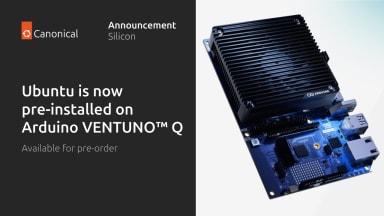
London, UK – August 25, 2026 – Following our initial collaboration announcement in March 2026, Canonical and Arduino (a subsidiary of Qualcomm Technologies, Inc.) are excited to announce that VENTUNO Q is now generally available for pre-order, pre-loaded with Ubuntu. VENTUNO Q is a dual-brain developer board designed for edge AI and robot

Welcome to this blog series which explores innovative uses of Ubuntu Core. Throughout this series, Canonical’s Engineers will show what you can build with this Core 26 release, highlighting the features and tools available to you. In this first blog, Farshid Tavakolizadeh, Engineer Manager for Canonical’s Industrial team, will show you h
Legacy infrastructure was not designed for the requirements of the AI era. While large-scale model training remains centralized in data centers, test-time inference is rapidly shifting to the edge to reduce latency and bandwidth consumption. This shift creates a new frontier for enterprise AI, but deploying at the edge introduces signific
Previous articles walked through RDMA (Remote Direct Memory Access) as a programming model and InfiniBand as the fabric that was built around it. Both led to the same conclusion, even if it was never stated outright: moving data, not compute, becomes the bottleneck once systems scale. So what happens when you want RDMA, but you’re
Welcome to this blog series which explores innovative uses of Ubuntu Core. Throughout this series, Canonical’s Engineers will show what you can build with our releases, highlighting the features and tools available to you. In this blog, Asa Mirzaieva, engineer from the Silicon Alliances team, will show you how to deploy optimised AI model

When distributed workloads stall because nodes cannot exchange small messages quickly and consistently, the network is the limiting factor. How do you solve that problem? InfiniBand offers one solution. InfiniBand is an interconnect, meaning the end-to-end communication system that links compute, storage, and accelerator nodes. It is impl
By packaging OpenShell as a snap, Canonical is enabling enterprises to confidently run next-generation agentic workflows across local devices, hybrid environments, and private clouds.
I’ve yet to meet a developer that enjoys working with metered AI APIs. The need to pay for every API call in development works in direct opposition to the ethos of rapid iteration, and it’s easy for the costs to get out of hand. That’s why Canonical has created a different approach to building AI-powered
AI is accelerating and improving how security engineers find and fix vulnerabilities. A new tool developed and used at Canonical, called Redhound, has already uncovered three critical logic vunerabilites, paving the way for a more secure software landscape.
Many of us are familiar with the retrieval augmented generative AI (RAG) pattern for building agentic AI applications – like digital concierges, frontline support chatbots and agents that can help with basic self-service troubleshooting. At a high level, the flow for RAG is fairly clear – the user’s prompt is augmented with some relevant
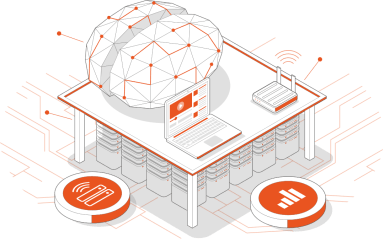
As AI platforms grow into large-scale “AI Factories,” the real bottleneck shifts from model design to operational complexity. With expensive GPU accelerators, hardware failures and inconsistent configurations lead directly to lost throughput and reduced return on investment. While Kubernetes orchestrates workloads, it cannot fix broken ph
Modern data centres are hitting a wall that faster CPUs alone cannot fix. As workloads scale out and latency budgets shrink, the impact of moving data between servers is starting to become the most significant factor in overall performance. Remote Direct Memory Access, or RDMA, is one of the technologies reshaping how that data moves,
Official Ubuntu support for the NVIDIA Rubin platform, including the NVIDIA Vera Rubin NVL72 rack-scale systems, announced at CES 2026 CES 2026, Las Vegas. – Canonical, the publisher of Ubuntu, is pleased to announce official support for the NVIDIA Rubin platform and the latest distributions of the new NVIDIA Nemotron 3 open models. As A