
Blog posts tagged "documentation"
For many software teams, documentation is written after features are built and design decisions have already been made. When that happens, questions about how a feature is understood or used often don’t surface until much later. A little over one year ago, our team began to recognize this pattern in our own work. Features generally
FOSDEM is one of the biggest and most exciting open source events of the year, held at the Solbosch campus of the Université Libre de Bruxelles (Brussels), Belgium. Thousands of open source contributors and enthusiasts attend, often with several folks from Canonical among them. The next one is coming quickly, with FOSDEM 2026 being held
Canonical’s Platform Engineering team has been hard at work crafting documentation in Rockcraft and Charmcraft around native support for web app frameworks like Flask and Django. It’s all part of Canonical’s aim to write high quality documentation and continuously improve it over time through design and development processes. One way we i
Typically, a technical writer takes the product created by a development team, and writes the documentation that expresses the product to its users. At Canonical we take a different approach. Documentation is part of the product. It’s the responsibility of the whole team. Documentation work is led by a technical author, who is part of the

tldr; Our Open Documentation Academy starts this week with our first weekly Documentation Office Hours on Friday 1st March 2024 at 16:00 UTC. Everyone is welcome! Keep reading, or see our forum post for more details and to leave questions. Many of us at Canonical wouldn’t be here if it wasn’t for Linux and open

We want you to join our Ubuntu circle, and help us document MAAS. More minds, more eyes, more hands make better doc.

Anyone who has ever built a product wants user feedback – and we in open source want it more than anyone else, and place higher demands on it than anyone else. However, this feedback can be hard to give, hard to receive, and hard to act upon. My product is open source software documentation, and

To help bring our ambitious documentation plans to fruition, we’re going to be hiring people to work in documentation – over the next couple of years, we’ll be increasing the number of Technical Authors at Canonical four-fold. This isn’t about documentation alone. If documentation is part of a product, and documentation work is part of

In February of this year the Multipass team took on a challenge: completely overhauling our documentation. Canonical has put a renewed emphasis on documentation in recent months, led by Daniele Procida and his Diataxis framework, and we wanted to be an early adopter of this methodology. We had no idea where to start, but fortunately
Following on from our previous post about accessibility by design, we’d like to share our accessibility documentation process here in the Web & Design team. In the Vanilla squad, we work hard to make sure the Vanilla framework is as accessible as possible. We don’t claim to be perfect, but accessibility is a real priority

Sooner or later, almost everyone who looks at some software that they or their team have created imagines a user getting to grips with it, and a pang of empathy for that unknown person prompts them to think: what we need here is a tutorial. And they are always absolutely right. In the Diátaxis documentation
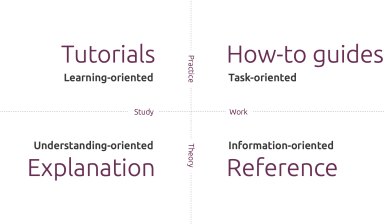
Our on-going documentation transformation project aims to make our documentation the best it can possibly be – an exemplar of excellence for the industry. We’re working on four distinct pillars of documentation to achieve this. The first of these pillars is direction. It defines what is quality in documentation, and answers the question:
Our software documentation is part of how we talk to each other – our users, our colleagues, our community. It’s a way we demonstrate how we value each other – including how we value you. We’ve understood the importance of this for some time, but actually finding a way to express those values in our
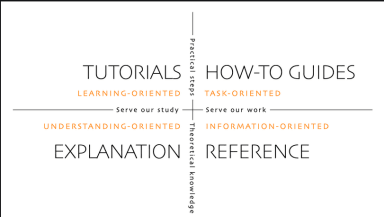
We discovered the Diátaxis Framework earlier this year. It’s been on our roadmap to shift MAAS doc to this cool new way of explaining things. This cycle, we plan to make it happen. You’d think it would be obvious…. Diátaxis is one of those ideas. Once you see it, you can’t figure out why everybody
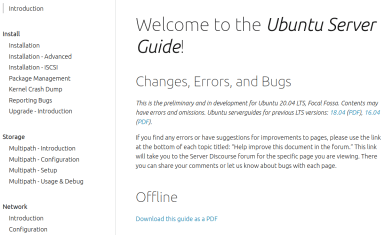
This article originally appeared on Joshua Powers’ blog With the release of Ubuntu 20.04 LTS (Focal Fossa) the Ubuntu Server Guide has received a major set of updates and has moved to a new location on the Ubuntu website. The new location makes it much easier to read and contribute improvements. There is a link
Ubuntu OS is open source, with a whole community working to shape and support it. Here are some resources from the Ubuntu community for the Ubuntu community.