
Blog posts tagged "ROS2"
Welcome to Part 2 of the “optimise your ROS snap” blog series. Make sure to check Part 1 before reading this blog post. This second part is going to present initial optimisations already used in the Gazebo snap. We will present the benefit that they could bring to our ROS snaps as well as the
Do you want to optimise the performance of your ROS snap? We reduced the size of the installed Gazebo snap by 95%! This is how you can do it for your snap. Welcome to Part 1 of the “optimise your ROS snap” blog series. This series of 6 blogs will show the tools and methodologies
Application orchestration is the process of integrating applications together to automate and synchronise processes. In robotics, this is essential, especially on complex systems that involve a lot of different processes working together. But, ROS applications are usually launched all at once from one top-level launch file. With orchestra
If you already tried to package ROS 2 Foxy applications into snaps, you might have encountered the following error regarding shared memory: This log is stating that FastDDS (formerly known as FastRTPS) couldn’t create a file for the shared memory mechanism due to denied permission. Fortunately, FastDDS is smart enough to fallback to a non
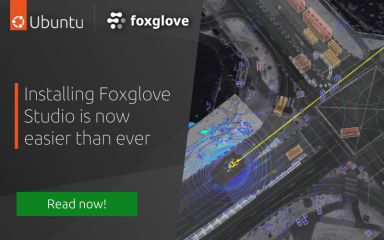
Today, Foxglove announced the release of the Foxglove Studio snap. Foxglove Studio helps you experience the world as a robot does, providing a rich set of features to visualise data. By diversifying its distribution with a snap, Foxglove Studio is now available to millions of Linux users that can install this open-source tool with a

We’re excited about the recent release of ROS 2 Humble Hawksbill, a Long Term Support (LTS) distro, supported for the next five years. ROS 2 releases come out on every even-numbered year together with the LTS release of Ubuntu, this time with Ubuntu 22.04 (Jammy Jellyfish). Earlier this week, we shared a step-by-step guide to
We welcome the new release of ROS 2 Humble which targets the recently released Ubuntu 22.04. If you want to install it now, please visit the ROS 2 Humble documentation. But if you want to install ROS 2 Humble and test compatibility, keeping your current Ubuntu (20.04, 18.04,…) environment stable until you know you are

Learn more about DDS, and how to stay protected while using it If you are currently running the Robot Operating System 2 (ROS 2), this piece is especially relevant to the security of your robots. A few weeks ago, a group of security researchers reported 13 security vulnerabilities affecting some of the most used implementations
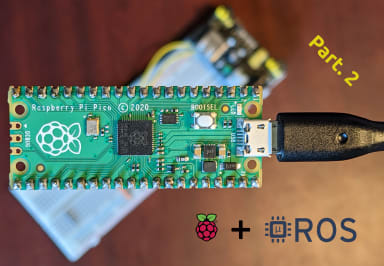
In this post, we will see how to wire up an HC-SR04 range sensor to the Raspberry Pi Pico and publish its readings to the ROS 2 graph using micro-ROS. This builds upon the previous post ‘Getting started with micro-ROS on the Raspberry Pi Pico’. As such, I’d encourage you to read it first if

Canonical ROS ESM customers now can access a long-term supported ROS and Ubuntu environment by the Ubuntu and ROS experts. Learn more about ROS ESM. 6 April 2021: Canonical and Open Robotics announced today a partnership for Robot Operating System (ROS) Extended Security Maintenance (ESM) and enterprise support, as part of Ubuntu Advantag
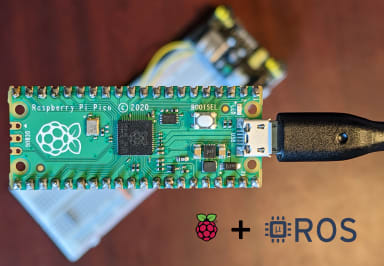
In this post we will see how the Raspberry Pi Pico can natively speak to a ROS 2 graph using micro-ROS. We will set up a project in VSCode, compile and upload it to the microcontroller. We thus assume that you are somewhat familiar with ROS 2 development and VSCode. What is this all about?

Goodbye Thanksgiving (well, for some of us), hello Christmas! The holiday season really is the best, and it always brings interesting robotics news, which we will now distill into a quick dose of delightful and easily-digestible tidbits. As always, if you’d like to see your work showcased here, please send an email to robotics.community@c

Construct a prototype ROS 2 system distributed across multiple computers using Kubernetes. Our goal is not only to provide you with a working configuration, but also to help you understand why it succeeds and overcome future design challenges.

The myriad of different fields that make up robotics makes QA practices difficult to settle on. Field testing is the go-to, since a functioning robot is often proof enough that a system is working. But online tests are slow. The physical environment must be set up. The entire system has to be in a workable
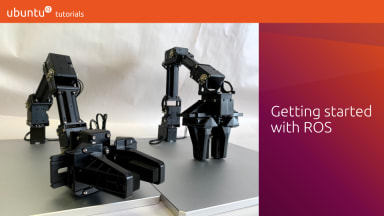
ROS, the Robot Operating System, is the platform of choice for robot development. However, the breadth and depth of existing documentation can be daunting for the ROS beginner. Where should you start learning about ROS 2 on Ubuntu? All robots based on ROS and ROS 2 are programmed using five simple but core constructs: Nodes
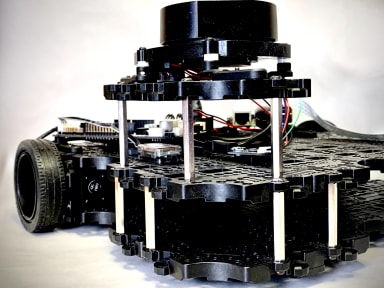
Interested in getting started in robotics? There’s no need to purchase expensive hardware before you try some things out: simulate a TurtleBot3 instead! The simulator is complete with LIDAR, a camera, a gyro and many other sensors and actuators. You can also see this installation in action at the Ubuntu Robotics YouTube channel. Software